Thirteen Rules, Two Peach Baskets, and Zero Ambition: The Accidental Blueprint for a $10 Billion Sport
Thirteen Rules, Two Peach Baskets, and Zero Ambition: The Accidental Blueprint for a $10 Billion Sport
Most great inventions come with a myth attached — the lone genius, the eureka moment, the vision that nobody else could see. Basketball doesn't really have that myth, because the truth is so much more interesting.
The man who invented basketball wasn't trying to change sports. He wasn't chasing a legacy. He had a deadline, a gym full of bored students, and a janitor who happened to have two peach baskets sitting around. That's the whole origin story. Everything else — the NBA, March Madness, the 450 million people worldwide who play the sport today — came from a problem-solving exercise that was supposed to last one winter.
The Assignment Nobody Wanted
James Naismith was a 30-year-old Canadian physical education instructor studying at the International YMCA Training School in Springfield, Massachusetts when his supervisor handed him what amounted to an impossible task.
The school had a class of eighteen young men — most of them training to become YMCA directors — who were stuck inside during the brutal New England winter. They'd already exhausted the standard indoor activities of the era: calisthenics, marching drills, gymnastics. The class was restless, bored, and getting difficult to manage. Two previous instructors had tried to handle them and essentially given up.
Naismith's supervisor, Dr. Luther Gulick, gave him two weeks to invent a new indoor game that would keep the students active, engaged, and out of trouble. Gulick wasn't asking for something revolutionary. He just needed something that worked until the weather broke.
Naismith later described the assignment as the most difficult challenge of his professional life. He spent the first week trying to adapt existing outdoor games — soccer, lacrosse, football — for an indoor gymnasium. Every version ended in collisions, broken equipment, or someone getting hurt. The hard floors punished the physical contact that made outdoor sports exciting.
He went back to basics.
Thirteen Rules Before Breakfast
The core insight Naismith landed on was counterintuitive: remove the running. If players couldn't move with the ball, the violent tackling and charging that made contact sports dangerous indoors would become pointless. The game would have to be built around passing, positioning, and accuracy instead.
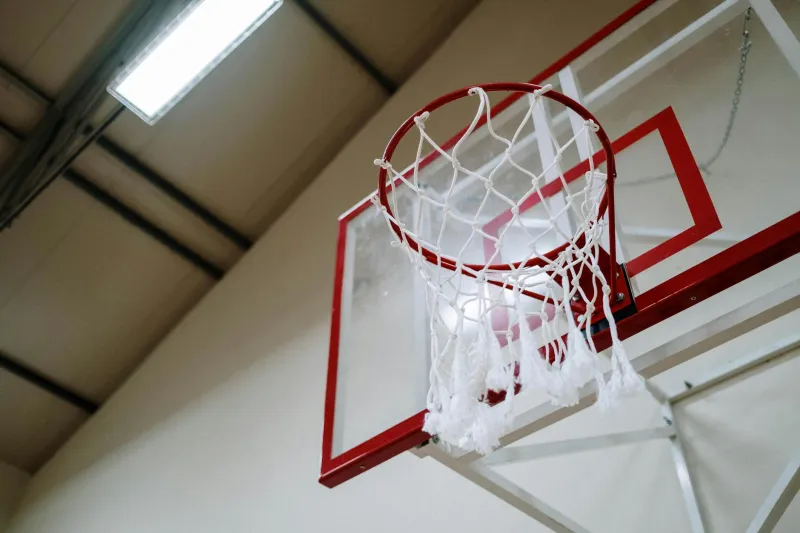
For the goal itself, he initially imagined boxes mounted at each end of the gym. When he asked the building's janitor if there were any boxes available, the janitor came back with two peach baskets instead. Naismith nailed them to the lower railing of the balcony that ran around the gym — which happened to sit at exactly ten feet above the floor. That height wasn't chosen for any scientific reason. It was just where the railing was.
He wrote out thirteen rules the following morning. The document took him less than an hour. He posted it on the gymnasium bulletin board on December 21, 1891, and the first game was played the same day with nine players on each side.
The students loved it immediately. Within weeks, they were writing home about it. YMCA directors who trained at Springfield brought the game back to their home cities. By the spring of 1892, basketball was being played in dozens of locations across the country. Naismith had barely finished refining the rules.
The Part Nobody Remembers
Here's the detail that tends to get lost in the origin story: those peach baskets had solid bottoms.
Every time someone scored, play had to stop while someone climbed a ladder to retrieve the ball. This went on for years — not months, years — before someone thought to cut a hole in the bottom of the basket. The open-bottomed net didn't arrive until 1906. The backboard came around the same time, invented largely to stop fans sitting in the balcony from interfering with shots.
The sport that became the NBA was, for its first fifteen years, played with a ladder nearby and a janitor on standby.
Naismith himself was famously unbothered by the commercial explosion that followed. He lived long enough to see basketball become an Olympic sport in 1936 — he was there in Berlin to watch the first gold medal game — but he never patented the game, never sought royalties, and spent most of his later career as a physical education professor at the University of Kansas, where he coached the team to a losing record and seemed genuinely unconcerned about it.
The man who invented basketball is the only coach in Kansas Jayhawks history with a losing record. The sport's creator finished his coaching career below .500. That detail alone says everything about what Naismith was actually trying to do in December 1891.
From Peach Baskets to Prime Time
The Basketball Association of America — which eventually became the NBA — was founded in 1946, more than fifty years after that first game in Springfield. March Madness, now one of the most-watched sporting events in the American calendar, draws roughly 100 million viewers annually. The global basketball market is valued somewhere north of $10 billion.
And somewhere underneath all of it, there's a physical education instructor with a two-week deadline, a janitor with a couple of spare baskets, and a balcony railing at exactly the right height.
Naismith didn't invent basketball because he saw the future. He invented it because he needed to get through February. The fact that it outlasted the winter, and the century, and every other indoor game ever devised — that part was never part of the plan.
Some of the most enduring things ever built were built on zero ambition and a very short deadline.