When Coaches Just Talked Strategy: How Movies Invented the Inspirational Halftime Speech
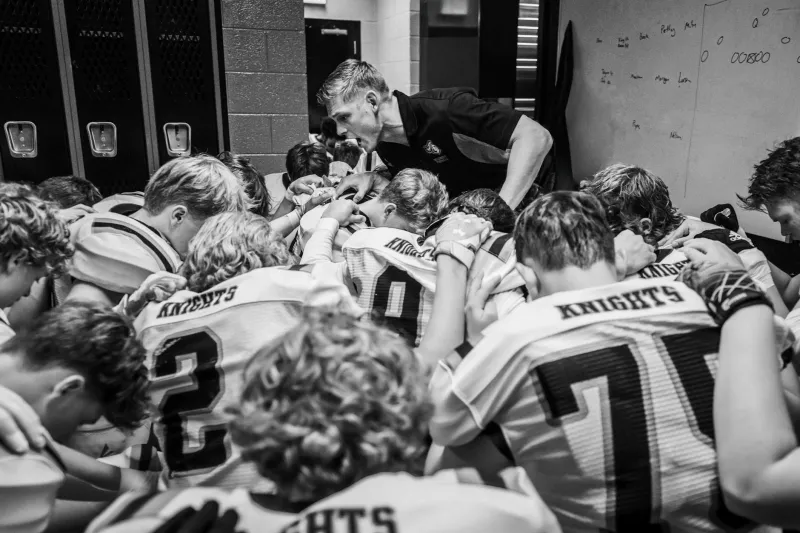
Picture this: It's 1925, and Notre Dame's football team trudges into the locker room at halftime, trailing by two touchdowns. Coach Knute Rockne pulls out his clipboard, sketches a few plays on the chalkboard, and tells his players to "run the sweep more to the outside." No tears. No dramatic music. No mention of dying teammates or childhood dreams.
That's because the inspirational halftime speech—the kind that makes grown men weep and transforms losing teams into champions—didn't exist yet. It was Hollywood's invention, not football's.
The Quiet Years of Coaching
For the first half-century of organized American sports, halftime talks were exactly what you'd expect from a tactical timeout: brief, practical, and forgettable. Coaches used the break to adjust formations, point out defensive weaknesses, and maybe remind players to keep their heads up. The locker room was a workspace, not a shrine.
"Halftime was for catching your breath and fixing what wasn't working," explains sports historian Dr. Robert Davies. "Coaches weren't trying to inspire anyone—they were trying to win games with better strategy."
Even the legendary Vince Lombardi, now synonymous with motivational speaking, spent most of his halftime talks diagramming plays on a blackboard. His famous quotes about winning and excellence? Those came from press conferences and practice sessions, not locker room sermons.
Hollywood Discovers the Locker Room
Everything changed in 1940 when Warner Bros. released "Knute Rockne, All American." The film featured Ronald Reagan as Notre Dame player George "The Gipper" Gipp, and Pat O'Brien as coach Rockne delivering the now-famous "Win one for the Gipper" speech.
There was just one problem: Rockne never gave that speech.
The real story was far more mundane. Gipp had died of pneumonia in 1920, and Rockne occasionally mentioned him to motivate players. But the dramatic deathbed scene and the tear-jerking halftime rally? Pure Hollywood fiction, crafted by screenwriters who understood that audiences wanted emotion, not X's and O's.
"That movie created a template," says film historian Janet Morrison. "Suddenly, every sports story needed a moment where the coach transforms his team with words alone."
The Birth of a Myth
The "Gipper" speech worked so well that Hollywood kept using the formula. Movies like "Jim Thorpe: All-American" (1951) and "The Pride of St. Louis" (1952) featured coaches delivering increasingly elaborate halftime orations. Television picked up the trend, with shows like "The White Shadow" and "Friday Night Lights" making the inspirational speech a weekly requirement.
By the 1980s, the fictional version had become more famous than reality. Young coaches grew up watching these movies and TV shows, unconsciously absorbing the idea that great coaches were great speakers first, strategists second.
When Fiction Became Expectation
The transformation accelerated with ESPN's rise in the 1980s and 1990s. Sports media needed content, and dramatic locker room moments made perfect television. Suddenly, cameras were following coaches into halftime, and what had once been private tactical discussions became public performance art.
Coaches found themselves in an impossible position. Fans, players, and media all expected inspiring speeches, even when the team just needed to run better pass routes. The quiet strategic adjustments that had defined coaching for generations were now seen as inadequate leadership.
"I've had coaches tell me they feel pressure to be motivational speakers," admits longtime college football coach Mike Chen (whose name has been changed for this story). "Sometimes the best halftime talk is 'Stop missing your assignments,' but that doesn't sound very inspiring."
The Performance Trap
Today's coaches exist in a strange liminal space between reality and fiction. They know that games are usually won by better preparation, superior conditioning, and tactical adjustments. But they also know that players, fans, and media expect them to channel their inner Hollywood coach when the stakes are high.
Some embrace the performance. Others resist it, focusing on practical improvements while letting assistants handle the emotional appeals. A few have found middle ground, using brief motivational moments to supplement, not replace, strategic discussions.
The Real Game-Changers
Ironically, while coaches have been pressured to become motivational speakers, the most effective halftime adjustments remain boringly practical. Alabama's Nick Saban is famous for his calm, analytical halftime approach. New England Patriots coach Bill Belichick treats halftime like a brief tactical seminar. Both have won multiple championships without delivering a single speech worthy of Hollywood.
"The best coaches I've worked with save the emotion for when it really matters," explains former NFL assistant coach Maria Rodriguez. "Most of the time, halftime is about solving problems, not changing hearts."
The Legacy of a Fictional Speech
The inspirational halftime speech has become so embedded in American sports culture that it's impossible to imagine the games without it. High school coaches feel obligated to deliver them. College programs film them for recruiting videos. Professional teams leak them to generate fan excitement.
But perhaps the most surprising thing about this cultural institution is how recent it really is. For most of sports history, coaches were tacticians, not philosophers. The idea that they should also be inspirational speakers is barely 80 years old—younger than many of the stadiums where these speeches are delivered.
So the next time you watch a coach deliver a passionate halftime rally, remember: You're not witnessing an ancient coaching tradition. You're watching the influence of Hollywood screenwriters who decided that sports stories needed more drama than a simple clipboard talk could provide.
Sometimes the most powerful backstories are the ones that never actually happened.