The Body Count Behind the 100-Yard Line: How a Presidential Ultimatum Shaped the Modern Football Field
The Body Count Behind the 100-Yard Line: How a Presidential Ultimatum Shaped the Modern Football Field
You've seen it thousands of times. The crisp white lines. The end zones. The hash marks stretching from the 10 to the 50 and back again. A hundred yards of perfectly measured turf that feels as permanent and obvious as gravity itself. But here's the thing about the modern football field: it isn't obvious at all. It's the result of a crisis — a genuine, life-or-death emergency — that nearly ended the sport entirely before it ever became America's obsession.
Football's Violent Early Years
To understand why the field is laid out the way it is, you have to travel back to a version of football that would be almost unrecognizable today. In the 1880s and 1890s, the game was played mostly at the college level, and it was brutal in ways that went well beyond hard hits and bruised ribs. The dominant strategy of the era was the "mass play" — formations where entire teams would lock arms and bulldoze forward in a human battering ram. The most infamous of these was the "flying wedge," introduced in 1892, which sent a V-shaped wall of blockers hurtling toward a single defender at full speed.
The injuries were catastrophic. Players suffered broken bones, severe concussions, and internal trauma. Deaths were not uncommon. In the 1905 season alone, at least 18 college football players were killed and more than 150 were seriously injured — numbers that triggered a national moral panic. Newspapers ran editorials calling for the sport to be banned outright. Universities began dropping their programs. The public outcry was loud and it was real.
Roosevelt Steps In
Among those paying close attention was President Theodore Roosevelt. A lifelong advocate of what he called "the strenuous life," Roosevelt genuinely believed in the value of athletic competition and physical toughness. But even he couldn't ignore the mounting death toll, especially after seeing graphic photographs of injured players published in newspapers across the country.
In October 1905, Roosevelt summoned representatives from Harvard, Yale, and Princeton — the most powerful football programs in the nation — to the White House. His message was direct: reform the game or face the very real possibility that the federal government would step in and shut it down. It wasn't a gentle suggestion from a fan. It was a political ultimatum.
The meeting triggered an urgent reform movement. In December 1905, a group of schools met in New York and formed what would eventually become the NCAA. Their immediate task was to overhaul the rules of football from the ground up — not just to reduce violence, but to restructure the entire logic of how the game was played.
Redesigning the Game — and the Field
The reforms that followed over the next several years were sweeping. The forward pass was legalized in 1906, which fundamentally changed the geometry of the game by spreading players across the width of the field rather than piling them into a single mass. The flying wedge and similar formations were banned. Rules around blocking and tackling were tightened significantly.
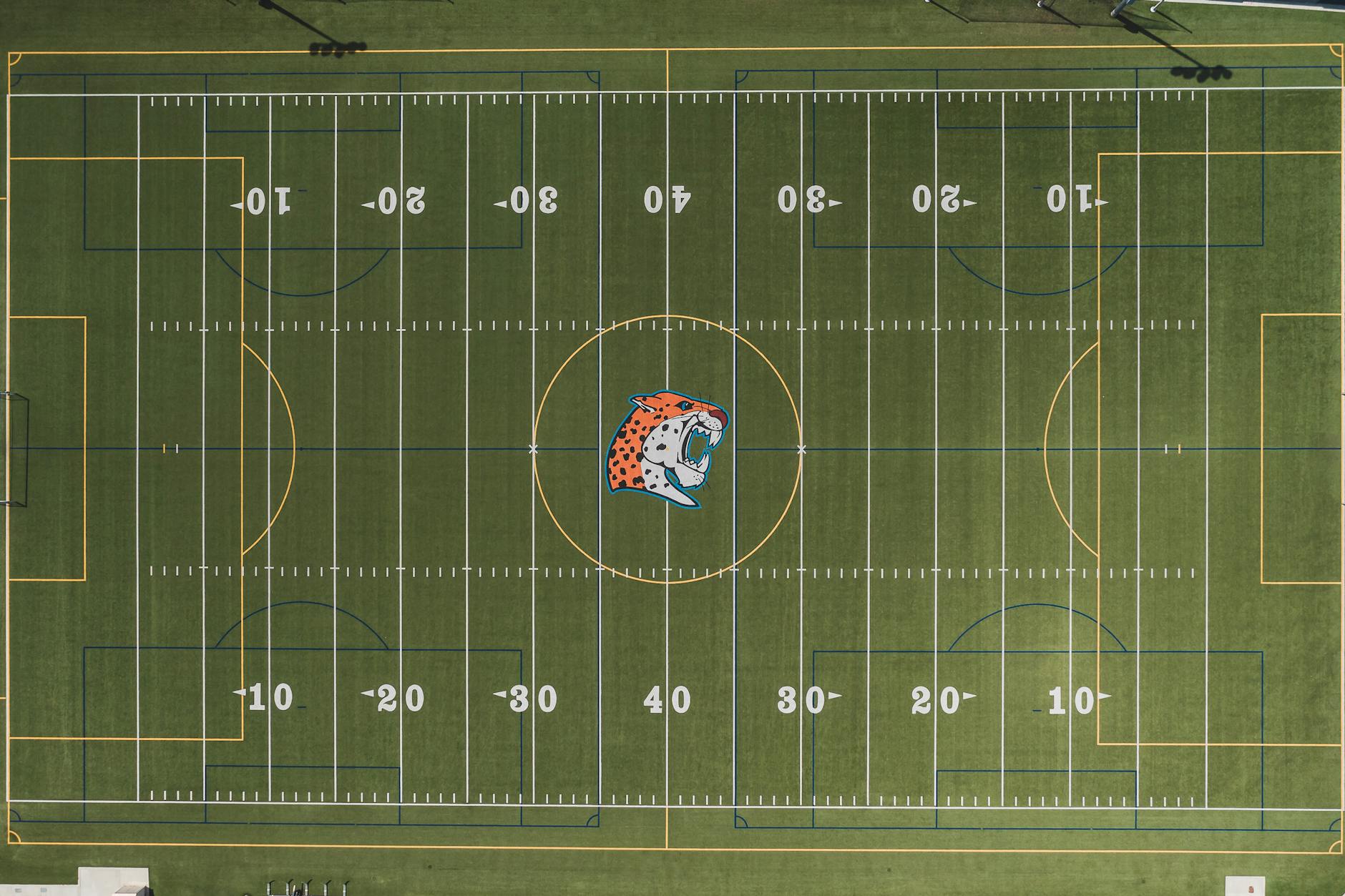
And the field itself was part of the solution. The standard dimensions — 100 yards of playing field with 10-yard end zones at each end — were formalized as part of this broader rationalization of the sport. The measurements weren't arbitrary. They were designed to give the newly legalized open passing game room to breathe, to spread out the action, and to reduce the kind of close-quarters pile-ups that had been killing players. The hash marks, yard lines, and standardized dimensions created a structured environment that made the game both safer and, as it turned out, far more watchable.
The 100-yard field wasn't handed down from some ancient sporting tradition. It was engineered under pressure, in a hurry, by people who were genuinely afraid the sport might not survive the decade.
From Crisis to Cathedral
What's remarkable is how completely those emergency decisions calcified into permanence. The football field we know today — the one you see on Sunday afternoons in sold-out stadiums holding 80,000 people, the one broadcast to hundreds of millions of viewers around the world — is essentially the product of a panicked reform committee working in the shadow of a presidential threat in 1905.
The violence problem, of course, never fully went away. The NFL continues to grapple with concussion research, player safety protocols, and rule changes designed to protect players more than a century after Roosevelt's White House meeting. In that sense, the conversation that shaped the field's dimensions is still very much ongoing.
But the next time you watch a quarterback drop back to the 30-yard line and launch a spiral toward the end zone, you're watching a game that was specifically redesigned to make that moment possible — and a field that was measured out not by tradition, but by necessity.
A hundred yards. It sounds simple. The story behind it is anything but.