Dirt, Confusion, and a Yellow Coat of Paint: The Unlikely Journey of the Pencil
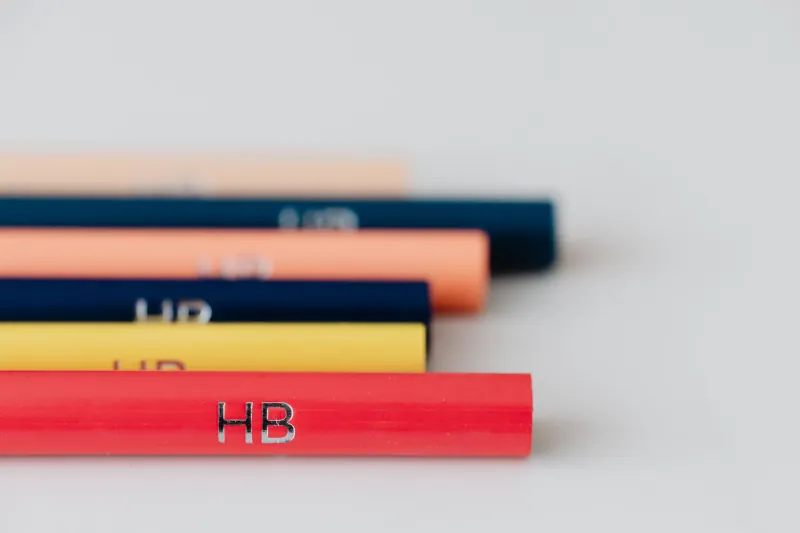
You've probably got one within arm's reach right now. Maybe it's rolling around in a kitchen drawer, or sitting in a cup on your desk next to three pens that don't work. The pencil is so ordinary, so completely unremarkable, that most people never stop to wonder how it got there. Which is exactly why its backstory is so good.
Because it starts with a storm, a fallen tree, and a mineral that nobody could figure out.
The Strange Black Rock That Confused Everyone
Sometime around 1565, in the Borrowdale valley of Cumbria, England, a violent storm uprooted a large tree and exposed something unusual in the soil beneath its roots. It was a dark, waxy mineral that left marks on everything it touched. Local shepherds, being practical people, figured out pretty quickly that it was useful for marking their sheep before sending them to market.
But beyond that, nobody really knew what they were dealing with. Miners called it "black lead" because it looked a little like lead ore. Scientists of the era were equally baffled. Some thought it was a form of carbon. Others thought it might be a kind of lead compound. For a while, the working theory was that it was simply a weird variety of molybdenum. It wasn't until 1779 that a Swedish chemist named Carl Wilhelm Scheele finally confirmed what the substance actually was: pure carbon. The name "graphite" came shortly after, derived from the Greek word graphein, meaning "to write."
But here's the thing — by the time scientists sorted out the chemistry, people had already been writing and drawing with the stuff for over two centuries. The pencil didn't wait for anyone to understand it. It just got to work.
From Sheep Marks to Wrapped Sticks
In those early decades after the Borrowdale discovery, raw graphite was simply broken into rough sticks and used directly on paper. It worked, but it was messy. The mineral crumbled, it dirtied your hands, and it was fragile enough to snap if you pressed too hard.
The first real innovation came from Italian craftsmen in the late 1500s who figured out that you could wrap the graphite stick in string or sheepskin to make it easier to hold. It was a small fix, but it changed the object from a rock you held to a tool you used.
The wooden casing came next — and credit for that goes, somewhat unexpectedly, to a pair of carpenters in Nuremberg, Germany. By the early 1600s, craftsmen there had developed a method of hollowing out a thin piece of wood and inserting a graphite core. The result was something that looked remarkably close to the pencil you'd recognize today. Nuremberg became the center of pencil manufacturing in Europe for the next two centuries, and the city still celebrates that heritage.
Meanwhile, the English were guarding their Borrowdale graphite supply like a state secret. The deposit was so valuable — so uniquely pure and dense — that the mine was locked between workings and protected by armed guards. At certain points, exporting raw graphite from England was a criminal offense.
The Number 2 and the Man Who Made It Make Sense
For all the progress in pencil-making, there was still a massive problem by the late 18th century: quality was wildly inconsistent. Some pencils were soft and smudgy. Others were so hard they scratched the paper. Buying a pencil was basically a gamble.
A French engineer named Nicolas-Jacques Conté changed that in 1795. Working under wartime conditions — Napoleon's blockades had cut off France's access to English graphite — Conté developed a method of mixing powdered graphite with clay and firing the mixture in a kiln. By adjusting the ratio of graphite to clay, he could control the hardness of the pencil with precision. More clay meant a harder pencil. More graphite meant a softer one.
Conté's system became the foundation for the grading scale still used today. In the US, we use numbers: the higher the number, the harder the pencil. The Number 2 sits in the sweet spot — soft enough to write smoothly, hard enough not to smear everywhere. It became the standard for standardized tests, office use, and school classrooms across the country. When a Scantron sheet tells you to use a Number 2 pencil, it's following a system a French engineer invented during the Napoleonic Wars.
Why Yellow? The Answer Is Pure Marketing
And then there's the color. If you picture a pencil in your mind right now, it's almost certainly yellow. Not red, not blue, not the natural wood color you might expect. Yellow. But why?
The answer has nothing to do with function and everything to do with a 19th-century marketing decision designed to make a pencil feel expensive.
In the 1890s, the best graphite in the world was coming from a region near the Khumbu valley in the Himalayas — specifically from mines in the area that would later be associated with the Chinese and Siberian graphite trade. This graphite was considered premium, the good stuff, and it was associated in the public imagination with the luxury and mystique of the East.
An American company called the L&C Hardtmuth Company — which sold pencils under the Koh-I-Noor brand, named after the famous Indian diamond — decided to paint their pencils yellow as a deliberate nod to Chinese imperial colors. It was a branding choice meant to signal quality, prestige, and exotic origin. The message was: this pencil is made with the finest materials from the Far East.
The strategy worked almost too well. Other manufacturers copied the yellow color to compete. By the early 20th century, roughly 75 percent of American pencils were yellow, and the association was so deep that yellow simply became what a pencil looked like. The luxury signal had become invisible, absorbed into the object itself.
The Most Overlooked Tool on Your Desk
Today, global pencil production runs somewhere around 14 billion units a year. The average pencil can draw a line 35 miles long or write roughly 45,000 words before it runs out. It requires no battery, no software update, no wireless connection. You can use it underwater, in zero gravity, and at temperatures that would kill most electronics.
NASA famously spent significant resources developing a pen that could write in space. The Soviets, the story goes, just used pencils.
From a confused lump of black mineral in a muddy English field to the most quietly reliable tool in the modern world — the pencil didn't evolve through grand invention. It evolved through farmers, carpenters, wartime engineers, and one very clever marketing team with a thing for the color yellow.
Not bad for something you've been losing under your couch cushions your whole life.