One Man's Annoyance, a Billion Snack Machines: The Surprisingly Human Story Behind Vending
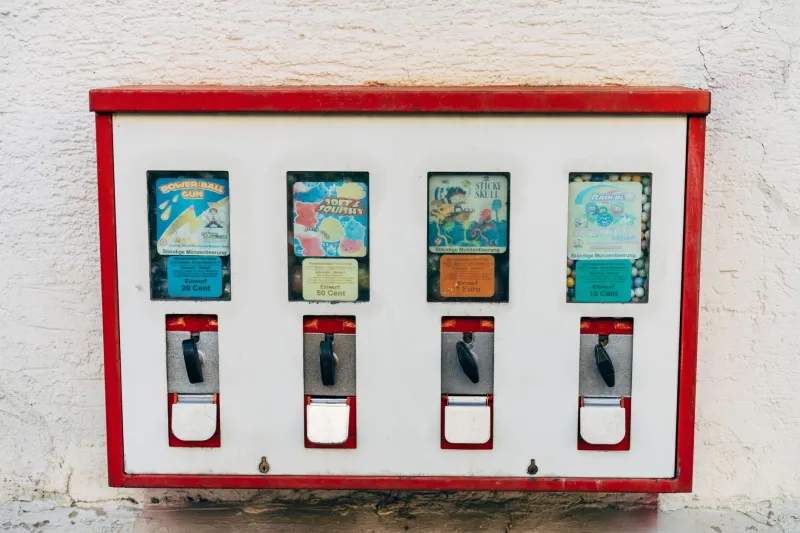
There's one in the hallway outside your office. There's probably one in the lobby of your gym, one in the hospital waiting room, one humming quietly in the corner of every college dormitory in America. You've stood in front of one at midnight, debating between the peanut butter crackers and the thing that might technically be a granola bar. The vending machine is so woven into American daily life that it barely registers anymore.
But it started with one extremely impatient man and a post office that moved too slowly.
The Postal Clerk Problem
In 1883, a British inventor and publisher named Percival Everitt was fed up. The post office, in his experience, was a bottleneck — slow clerks, long lines, the whole inefficient ritual of asking a human being to hand you something that required zero human judgment to dispense. Stamps were stamps. The transaction didn't need a person. It needed a machine.
Everitt designed one. His invention was a simple coin-operated box that accepted a penny and released a postcard or an envelope in return. He called it an "automatic clerk," which is a phrase that deserves more credit in the history of technology. He patented the device in 1883 and began placing them in London train stations, where foot traffic was high and the appeal of avoiding a queue was obvious.
The machines were a modest hit. They didn't change the world overnight, but they proved something important: people were willing to interact with a machine to get something they wanted, as long as the transaction was simple and the reward was immediate. That's a psychological principle so fundamental that the entire vending industry — and, arguably, a good chunk of the modern app economy — is still built on it.
Crossing the Atlantic
The concept made it to the United States by the late 1880s, and America, being America, immediately scaled it up.
The first major American deployment of vending technology came in 1888, when the Thomas Adams Gum Company installed machines on the elevated train platforms of New York City. The product was Tutti-Frutti gum. The logic was the same as Everitt's: commuters waiting for a train had time to kill, loose change in their pockets, and zero desire to hunt down a candy shop. Put the thing in front of them, make it easy, and they'll buy it.
They did. The New York experiment was successful enough that other companies started paying attention. By the turn of the century, vending machines were dispensing everything from peanuts to cigars to books. In 1902, the Horn & Hardart company opened what it called an "Automat" in Philadelphia — a full cafeteria where every item of food sat behind a small glass window, accessible with a coin. It wasn't quite a vending machine in the modern sense, but it was the same core idea: remove the human intermediary, lower the friction, let people feed themselves on their own schedule.
The Automat became a cultural institution in New York and Philadelphia for decades. At its peak, Horn & Hardart was serving nearly 800,000 customers a day. It was fast food before fast food existed, and it ran entirely on the logic Percival Everitt had sketched out in a London post office thirty years earlier.
The Break Room Revolution
The real transformation of American vending culture came after World War II, and it happened for a reason that had nothing to do with technology: the American workplace changed.
As manufacturing and office work expanded through the 1950s, companies were suddenly managing large numbers of employees who needed to eat during shifts but couldn't always leave the building. Company cafeterias were expensive to run. Bringing in outside food vendors was logistically complicated. The vending machine solved both problems at once. It required no staff, no kitchen, no lunch rush management. You plugged it in, stocked it, and let it run.
By 1960, vending machines were generating over $2 billion a year in US sales — a number that seems modest until you adjust for inflation and realize it represents a massive cultural shift in how Americans ate at work. The machine wasn't just a convenience anymore. It was infrastructure.
The industry kept evolving. Refrigerated machines arrived in the 1950s, making it possible to vend sandwiches and dairy products. Hot beverage machines followed. By the 1980s, machines could dispense full meals. Today, vending technology has moved into electronics, fresh produce, prescription medications, and even luxury goods — there are vending machines in some airports selling Beats headphones and iPhone chargers at prices that would make Percival Everitt's head spin.
The Third Place Nobody Named
Sociologists have a concept called the "third place" — the space between home and work where people decompress, socialize, and exist outside of their formal roles. Coffee shops are classic third places. So are barbershops, parks, and diners.
But there's an argument to be made that the vending machine alcove — that slightly fluorescent corner of every office, hospital, and school — functions as a kind of micro third place. It's where you run into the colleague you never see at your desk. Where you have the thirty-second conversation that somehow turns into an actual friendship. Where you stand for a moment, alone, making a low-stakes decision that is entirely your own.
That's a lot of weight for a machine that dispenses Doritos. But the vending machine has always been about more than what it sells. It's about the transaction — the simple, immediate, friction-free exchange that Everitt imagined standing in line at a post office in 1883, thinking there had to be a better way.
There was. It just took a hundred and forty years to fully figure out what it could become.
Still Running on the Same Idea
The vending machine industry in the US generates roughly $23 billion a year. There are approximately 7 million machines currently operating across the country — about one for every 47 Americans. Modern machines accept credit cards, Apple Pay, and in some cases facial recognition. They track inventory in real time, adjust prices based on demand, and send alerts when they're running low on the good stuff.
All of that technology traces back to a wooden box with a coin slot on a London train platform, built by a man who simply didn't want to talk to a postal clerk.
Some frustrations, it turns out, are worth having.