A 150-Year-Old Typewriter Jam Is Still Slowing Down Your Thumbs
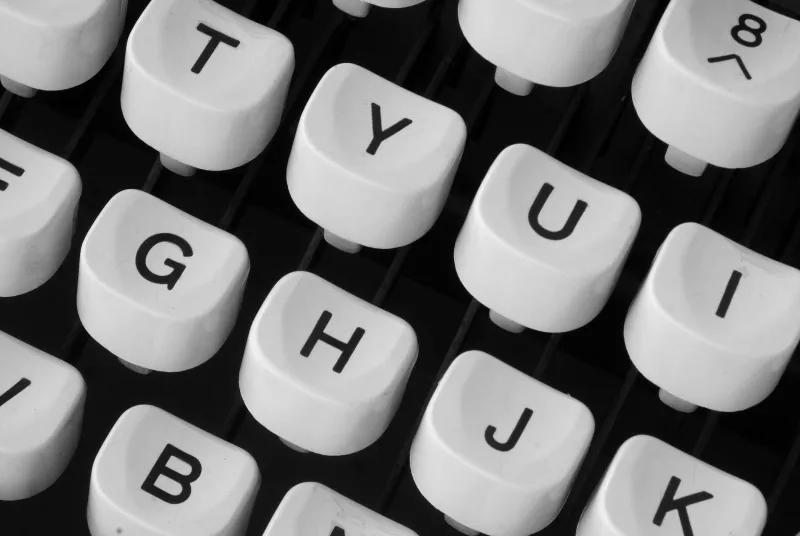
The next time you unlock your phone and fire off a text, take a second to look at the keyboard. Q-W-E-R-T-Y across the top. A-S-D-F-G in the middle. Z-X-C-V-B at the bottom. It probably looks completely natural to you. Inevitable, even.
It isn't. That arrangement was engineered in the 1870s to solve a mechanical problem inside a machine that no longer exists — and despite being demonstrably inefficient for modern typing, it has survived every attempt to replace it for over a hundred and fifty years. The story of how that happened is one of the more quietly absurd chapters in the history of everyday technology.
The Typewriter Had a Jamming Problem
Christopher Latham Sholes didn't set out to design the world's most enduring keyboard layout. He set out to build a machine that could type faster than a person could write. What he got, first, was a machine that constantly jammed.
Sholes and his collaborators filed the patent for an early typewriter in 1868. The machine used metal type bars — small arms with letters at the end — that swung up to strike an ink ribbon against paper. The problem was physics: when two keys close together on the keyboard were pressed in quick succession, the corresponding type bars would collide mid-swing and stick together, grinding the whole mechanism to a halt.
The solution Sholes landed on was counterintuitive. Instead of fixing the mechanical collision directly, he redesigned the keyboard to separate letters that were frequently typed together. By scattering common letter pairings across the keyboard — forcing the type bars for those pairs to swing from opposite sides — he reduced the frequency of jams.
QWERTY wasn't optimized for the typist. It was optimized for the machine.
Remington Scaled It Up
Sholes eventually sold his design to E. Remington and Sons, a company that had made its name manufacturing rifles and sewing machines and was now pivoting toward the emerging typewriter market. Remington made refinements, went into production, and by the 1870s was selling a commercial typewriter with the QWERTY layout to businesses across the country.
The timing mattered enormously. This was the era of the telegraph, of expanding railroads, of commercial correspondence exploding in volume. Businesses needed people who could type, and they needed them fast. Typing schools opened across American cities. Instructors trained on Remington machines. Students learned on Remington machines. An entire generation of office workers built their muscle memory on QWERTY.
By the time competitors entered the market with different keyboard arrangements, they faced an immediate problem: the trained typists already knew QWERTY. Hiring a typist meant hiring someone who knew QWERTY. Choosing a different layout meant retraining your entire workforce from scratch.
The layout had already escaped the machine. It was living in people's hands.
The Challenger That Should Have Won
In 1936, a professor named August Dvorak patented an alternative keyboard layout that was — by almost every measurable standard — better than QWERTY. He had spent years analyzing the frequency of letter use in English and arranged his layout so that the most common letters sat directly under the fingers on the home row. Typists could produce roughly seventy percent of common English words without ever leaving that row. On a QWERTY keyboard, that figure sits closer to thirty-two percent.
Dvorak's layout reduced finger travel distance significantly. Studies showed that trained Dvorak typists were faster and experienced less fatigue. The US Navy conducted trials during World War II and found that retraining typists on Dvorak paid for itself in increased speed within ten days.
QWERTY survived anyway.
The Navy's findings were disputed — some critics argued the study methodology was flawed, others pointed out that Dvorak himself had run the trial, introducing obvious bias concerns. But more fundamentally, the problem wasn't the evidence. The problem was scale. By the mid-20th century, QWERTY wasn't just a keyboard layout. It was the foundation of an enormous commercial ecosystem: typewriter manufacturing, typing instruction, office administration, corporate procurement. Replacing it would have required a coordinated overhaul of all of those systems simultaneously, and no single organization had both the incentive and the authority to make that happen.
Dvorak's layout is still available on virtually every computer and smartphone sold today. Almost nobody uses it.
The Digital Era That Changed Nothing
If there was ever a moment to break the QWERTY lock, it should have been the transition from typewriters to personal computers in the 1970s and 80s. The mechanical justification for the layout had been dead for decades. There were no type bars to jam. The physical constraint that had created QWERTY in the first place simply didn't exist in a digital environment.
And yet when IBM, Apple, and every other company designing personal computers sat down to decide what keyboard to ship, they chose QWERTY. Not because it was best. Because it was what people already knew. Asking consumers to learn a new keyboard layout to use a new computer was one friction too many in a market already asking people to make a significant behavioral leap.
The same logic played out again when smartphones arrived. Touchscreen keyboards had no physical constraints whatsoever. Designers could have laid out letters in any arrangement. They chose QWERTY — because the hundreds of millions of people they wanted as customers already knew it.
Every generation of new technology has inherited the keyboard of the previous generation, and every generation has decided that changing it wasn't worth the cost.
The Jam That Never Ends
The QWERTY keyboard is, in a sense, a fossil — a physical remnant of a mechanical problem that was solved and then forgotten, preserved not by logic but by the sheer weight of accumulated habit.
You type on it today because your parents typed on it, because their employers bought machines that used it, because a weapons manufacturer in upstate New York decided to scale up a design in 1873 that a Milwaukee inventor built to stop metal arms from crashing into each other.
The typewriter is gone. The jam it was designed to prevent is gone. The keyboard remains.
And somewhere, in a parallel universe where August Dvorak got better marketing, your thumbs are moving a lot more efficiently right now.