The Signal That Exploded: How a Trolley Wreck and a Cleveland Cop Gave Us the Traffic Light
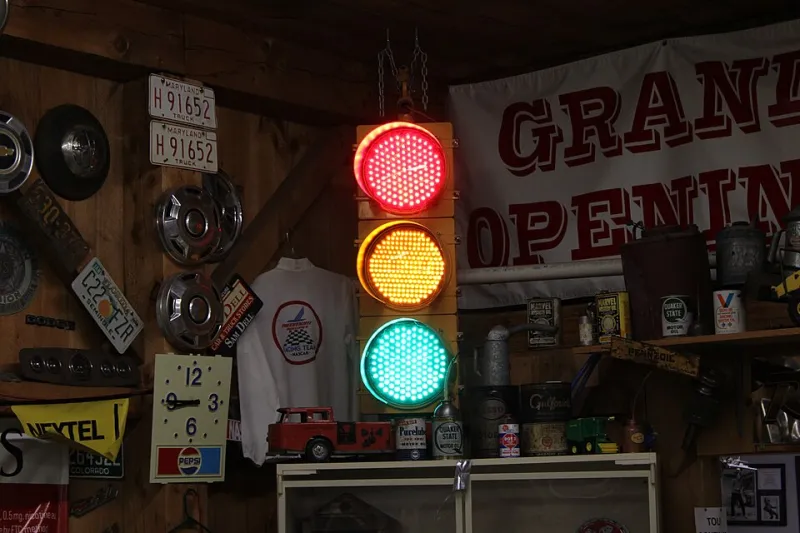
Photo: DogsRNice, CC BY-SA 4.0, via Wikimedia Commons
You sit at a red light every single day. You probably don't sit there thinking about the fact that the first version of that light had a nasty habit of exploding.
The traffic light feels like it has always existed, as permanent as the pavement itself. But the little red-and-green boss of every American intersection is actually the product of two very different worlds colliding: the railroads of the 1800s and the chaotic streets of early twentieth-century Ohio.
The Railroad Sent Its Colors to Town
Long before cars clogged city streets, trains already had a signaling language. Railroad engineers used colored lanterns and semaphore arms to communicate down the track — red meant danger, green meant clear. This wasn't arbitrary. Red had long been associated with hazard because it was the most visible, most alarming color available in lamps and dyes, and green stood out against it in low light.
When American streets started filling with trains, streetcars, bicycles, and eventually automobiles all fighting for the same space, cities did what any sensible institution does: they stole from an industry that had already solved the problem. Railroads had rules. Streets didn't.
The Signal That Blew Up
The first crack at a street signal came in London in 1868, when a gas-lit contraption with red and green arms was installed outside the Houses of Parliament to protect pedestrians. It worked, briefly. Then the gas leaked, the lantern exploded, and the policeman operating it was badly burned. The idea was quietly shelved for decades.
Meanwhile, American streets were getting genuinely deadly. By the early 1900s, automobiles were multiplying faster than anyone could write rules for them, and intersections had become free-for-alls governed by nerve and horn-honking.
A Cop, a Wire, and a Whistle
In Cleveland in 1914, a police officer named William Potts — working the crowded intersection at Euclid Avenue and 105th Street — got tired of directing traffic by hand. Potts, a Detroit police officer by some accounts and a Cleveland traffic engineer by others, is credited with wiring together railroad signals into a four-way electric light suspended over an intersection, giving America its first practical electric traffic signal in 1914. The American Traffic Signal Company soon began selling the design, and cities across the country started hanging lights over their busiest corners.
The system was crude. It ran on timers, not sensors, and early versions had no yellow at all — drivers got a red and a green and were expected to figure out the transition themselves. But it worked, and it spread.
Why Red and Green Won
The color scheme wasn't a creative choice; it was an inheritance. Railroad signaling already used red for stop and green for proceed, so the street version simply copied it. Yellow came later, added in the 1910s and 1920s by engineers — including Detroit's William Potts, who is often credited with the three-light system — to give drivers a warning phase and cut down on the crashes happening during color changes.
There was even a brief debate about swapping red and green. Some engineers argued that green, being easier on the eyes, should be the warning color. Railroad tradition won out, and the world standardized on red-as-danger, a convention so entrenched now that reversing it would be unthinkable.
The Intersection Became a Language
What started as a borrowed trick from the railroads is now one of the most universally understood systems on Earth. You don't need to speak English, read a sign, or know local custom to understand a red light. A Cleveland cop's improvised wiring project became a global grammar of the road.
Today there are smart signals that talk to cars and cameras that time lights to traffic flow. But the core idea — a colored lantern hanging over a dangerous crossing, borrowed from the railroad — hasn't fundamentally changed in a century.
So the next time you're stopped at a red light, tapping the wheel, consider that you're waiting on a signal that's the direct descendant of an exploding gas lamp, a trolley-clogged street, and a railroad engineer's lantern. Every intersection in America is a little piece of the 1800s, still telling you when to go.