The Candy Bar by the Register Wasn't an Accident. Neither Was Anything Else About That Line.
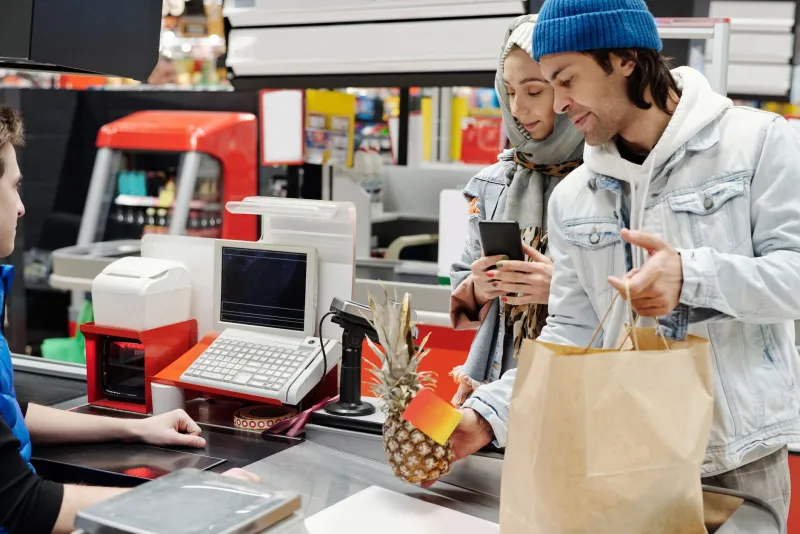
You've done it. You're standing in the checkout line at the grocery store, cart full, phone in hand, and somehow a Snickers ends up on the conveyor belt with everything else. You didn't go in for a Snickers. You didn't think about a Snickers for a single second during the entire shopping trip. But there it is.
That moment — that small, slightly embarrassing capitulation — is the end result of nearly a century of deliberate design. The checkout line isn't just a place to pay. It's a machine. And understanding where it came from changes the way you'll look at every store you walk into for the rest of your life.
Before the Checkout Line, There Was Chaos
In the early 20th century, most American grocery shopping worked like this: you walked in, told a clerk what you needed, and they retrieved it from shelves behind the counter. You never touched the merchandise directly. The store controlled what you saw, what you reached for, and what made it into your order.
Then, in 1916, a Tennessee entrepreneur named Clarence Saunders opened a store in Memphis called Piggly Wiggly — and quietly dismantled the entire model. Saunders had a radical idea: let customers walk the aisles themselves, pick up the products, and carry them to a register at the exit. Self-service grocery shopping, which we now take completely for granted, was genuinely novel.
It was also, from a theft-prevention standpoint, a complete nightmare.
The Bottleneck Was the Point
Saunders understood the risk he was taking. Open shelves and unattended merchandise meant shoplifting was now a structural vulnerability, not just an occasional problem. His solution was architectural: design the store so that every customer had to pass through a single, narrow exit point before leaving. One way in. One controlled way out.
The turnstile-gated checkout lane — which Piggly Wiggly patented as part of its store design — wasn't primarily about payment. It was about containment. You couldn't exit the building without passing an employee who could see what you were carrying. The register was a checkpoint as much as a cash drawer.
Saunders called this the "self-serving store" and patented the layout aggressively. But the concept spread anyway, and as it did, other retailers started noticing something unexpected: the bottleneck was creating a behavioral opportunity.
Waiting Is Expensive Real Estate
When you're moving through a store, you're in motion — making decisions, navigating the list in your head, comparing prices. But when you're standing in a checkout line, you stop. You wait. And waiting, it turns out, is one of the most exploitable states a retailer can put you in.
You're no longer planning. You're no longer comparing. You're just... there. Bored, mildly impatient, and surrounded by items specifically chosen because they're cheap enough to grab without thinking, small enough to fit in a hand, and satisfying enough to feel like a reward after the friction of a shopping trip.
The candy bar by the register wasn't placed there because it ran out of shelf space in the candy aisle. It was placed there because someone figured out that a person standing idle for ninety seconds, holding a wallet they're about to open anyway, is maximally susceptible to a $1.50 decision.
This is the impulse-buy industry — and the checkout lane invented it.
The Science Gets Darker From Here
By the mid-20th century, retailers had moved well beyond candy placement. Supermarket design had become a discipline, informed by time-motion studies, eye-tracking research, and behavioral psychology that most shoppers never knew was being applied to them.
Store layouts were engineered to maximize "dwell time" — the amount of time a customer spends in the building. Essential items like milk and eggs were pushed to the back corners so shoppers had to traverse the entire store to reach them. Aisle widths were calibrated to slow movement without creating frustration. Music tempos were adjusted to influence walking speed.
And the checkout zone evolved into its own micro-environment. Magazine racks appeared because waiting customers read headlines. Gum and mints showed up because breath anxiety is a reliable trigger. In the 1990s, loyalty card programs were introduced partly to collect data on exactly which impulse items converted most reliably at which locations in the checkout corridor.
The line you stand in is not passive infrastructure. It's active design.
The Digital Checkout and What It Reveals
The rise of self-checkout machines over the last two decades offered retailers a fresh dilemma: the traditional checkout lane's psychological architecture — the magazines, the candy, the deliberate narrowness — was built around a human cashier interaction. Remove the cashier and you disrupt the whole choreography.
So the industry adapted. Self-checkout screens now display promotional offers during the scanning pause. "Did you forget anything?" prompts appear at the payment step. Some chains have experimented with digital impulse-buy suggestions based on what's already in your cart.
The bottleneck moved from physical space to digital interface. The psychology stayed exactly the same.
A Checkout Line Is Never Just a Checkout Line
Clarence Saunders built his narrow exit lane to stop shoplifting in Memphis in 1916. He probably didn't imagine that the architecture of that one constraint would reshape American consumer behavior for the next century. But that's how these things tend to work — a practical solution to an immediate problem becomes a template, and the template becomes invisible, and the invisible becomes the standard.
The next time you find yourself holding a candy bar you didn't plan to buy, standing in a line you didn't choose to enter, in a store designed down to the inch to keep you there just a little longer — that's not a coincidence. That's a hundred years of retail history working exactly as intended.