The Horn That Shook the Factory Floor First: How Industrial America Built the Sound of Sports
There's a moment in a hockey arena that feels almost primitive. The puck crosses the goal line, and before the crowd fully processes what happened, a foghorn erupts — massive, chest-deep, slightly terrifying — and the building loses its mind. It's one of the most visceral sounds in American sports. Primal. Immediate. Impossible to ignore.
Where did that horn come from? Not from hockey. Not from sports at all. That sound — and dozens like it that now define the stadium experience — has its roots on the factory floor of industrial America, where loud, blunt, mechanical noise was the only reliable way to communicate with thousands of people at once.
The stadium didn't invent its own soundtrack. It borrowed one.
The Problem of Scale
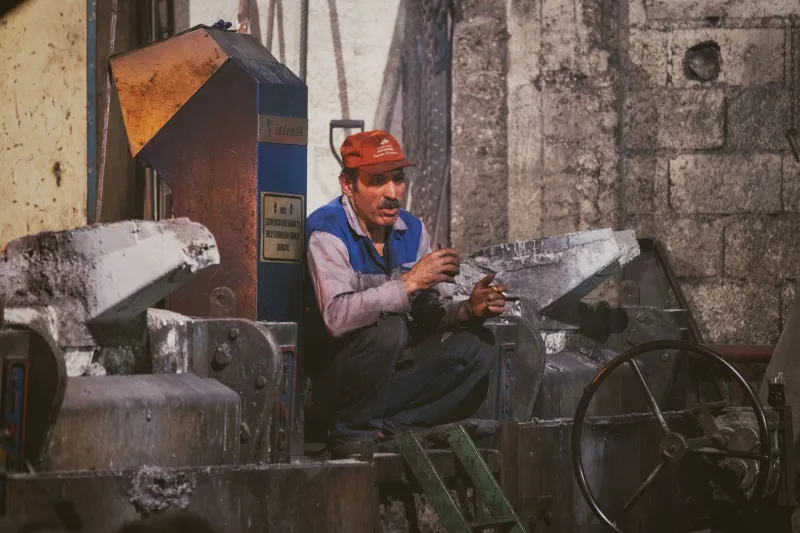
To understand why, you have to picture an American manufacturing facility in the late 19th century. Not a small workshop — a real industrial operation. Thousands of workers, running machinery so loud that spoken communication was effectively impossible across any meaningful distance. Shift changes, meal breaks, emergency stops — all of it required a signal that could cut through the noise and reach every corner of the floor simultaneously.
The solution was acoustic brute force. Steam whistles had been used on locomotives since the 1830s, and factory operators adopted them almost immediately. By the 1880s, the factory whistle was one of the defining sounds of American industrial life. It told you when to start work, when to stop, when to eat, when to go home. It organized tens of thousands of lives across entire cities.
In mill towns across New England and the industrial Midwest, the factory whistle was effectively the public clock. Workers set their routines by it. Neighborhoods were built within earshot of it. The whistle wasn't just a signal — it was infrastructure.
Sports Borrows Its Language
Organized American sports were scaling up at almost exactly the same time. Baseball crowds in the 1880s and 1890s were growing beyond what a single umpire's voice could manage. Football games at state universities were drawing thousands of spectators. Basketball, invented in 1891, needed a way to stop play instantly across a loud gymnasium.
The people designing these sports and their facilities faced the same fundamental problem the factory managers had already solved: how do you communicate a single, unambiguous message to a large, noisy crowd at an exact moment in time?
They reached for the same tools.
The referee's whistle — now so fundamental to sports that we barely think of it as a technology — was adopted directly from industrial and military signaling practice. The Fox 40, the Acme Thunderer, the pealess designs that followed: all of them descended from a tradition of using sharp, penetrating sound to command immediate attention in chaotic environments. The factory foreman blew a whistle to stop the line. The referee blew a whistle to stop the game. The logic was identical.
The Horn Gets Louder
As indoor sports venues grew through the early 20th century — from converted armories to purpose-built arenas — the acoustic demands escalated. A whistle that worked in a gymnasium struggled to register in a building holding fifteen thousand people. The solution, again, came from industry.
Foghorns and air horns had been developed for maritime and railroad use, designed to be audible over wind, water, and engine noise across significant distances. When arena operators needed something that could signal the end of a period or mark a goal in a way that every person in the building could hear without ambiguity, the industrial horn was the obvious answer.
The Montreal Canadiens are often credited with popularizing the goal horn in hockey, but the instrument itself was already a familiar object in the industrial North American soundscape. Shipyards used it. Rail yards used it. Steel mills used it. Bringing it into the arena wasn't a creative leap — it was a practical import.
Rhythm as Identity
What happened next is where the story gets genuinely interesting. Once these industrial sounds entered the stadium, they didn't just function as signals. They started accumulating emotional weight.
The factory whistle was neutral — it meant stop or start, nothing more. But in a sports context, the same sonic logic got attached to drama. The horn at the end of a period meant survival or defeat depending on the score. The goal horn meant elation. The referee's whistle meant interruption, sometimes injustice. The sounds hadn't changed. The emotional architecture around them had transformed completely.
Sports franchises began customizing their horn sounds in the latter half of the 20th century, treating them as part of team identity. The Chicago Blackhawks' goal horn is distinct from the Boston Bruins'. NFL stadiums developed signature horn blasts. The NBA layered horn sounds into elaborate in-game entertainment sequences. What started as borrowed industrial utility had become branded audio design.
Today, sound designers are hired specifically to craft the acoustic experience of a stadium — the horns, the walk-up music, the transition sounds between plays. It's a sophisticated creative discipline. But at the center of all of it, still doing exactly what it did in a steel mill in Pittsburgh in 1895, is a loud, simple, impossible-to-ignore blast of sound that says: pay attention, something just happened.
The Factory Is Still in the Room
American sports and American industry grew up together, and the sounds they share aren't coincidental. Both needed to coordinate large groups of people in real time. Both needed signals that were unambiguous, immediate, and physically impossible to miss. The factory solved that problem first, and sports inherited the solution.
The next time a goal horn sends a shockwave through an arena and you feel it in your ribs, remember: someone on a factory floor felt something very similar, a long time ago. The context was different. The technology was the same. And the sound — that enormous, democratic, chest-rattling blast — has been organizing Americans ever since.