Stuck Keys and Stubborn Habits: Why Your Keyboard Was Designed to Slow You Down
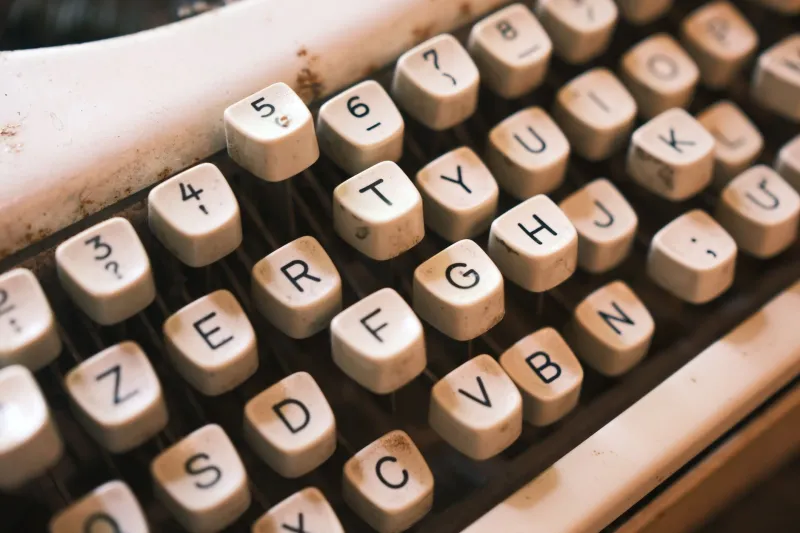
Every day, millions of Americans sit down at a laptop, a phone, or a desktop terminal and type without a second thought. The letters are just... there. Q, W, E, R, T, Y — a sequence so familiar it feels inevitable, like the order of the alphabet or the layout of a dollar bill. But there's nothing inevitable about it. In fact, the arrangement you've been using your entire life was specifically engineered to make typing harder.
That's not a conspiracy theory. That's the actual design brief.
A Machine That Kept Choking on Itself
To understand why, you have to go back to Milwaukee in the early 1870s, where a newspaper editor named Christopher Latham Sholes was trying to build a commercial typewriter. He wasn't the first person to attempt it — inventors had been tinkering with writing machines since the 1700s — but Sholes was among the first to get close to something practical.
The early prototype worked on a simple mechanical principle: press a key, a metal arm swings up and strikes an inked ribbon against paper. Clean, logical, satisfying. The problem was that when a typist moved quickly, those metal arms — called typebars — would crash into each other mid-swing and jam together in a tangled mess. The faster you typed, the worse it got.
Sholes and his collaborators noticed something important: the jams happened most often when commonly paired letters were positioned close together on the keyboard. If the typebars for "S" and "T" sat side by side, and you were typing the word "street," you were practically guaranteed a collision.
The solution was counterintuitive but effective: scatter the most frequently used letters as far apart as possible. Force the typebars to travel longer distances. Introduce just enough mechanical delay that the arms had time to fall back before the next one swung up.
In other words, they deliberately slowed the machine down to keep it from breaking.
The Layout That Stuck
The resulting arrangement — patented in 1878 and adopted by Remington, then the dominant typewriter manufacturer in the United States — was QWERTY. It wasn't elegant. It wasn't alphabetical. It wasn't even optimized for common English words. It was a workaround. A mechanical compromise.
But here's where the hidden backstory gets interesting: it worked. Not brilliantly, but well enough. Remington sold machines. Businesses bought them. Secretarial schools started training typists on the QWERTY layout. By the time competitors tried to offer alternatives, there was already a trained workforce that knew the keyboard by muscle memory. Switching layouts meant retraining everyone — and nobody wanted to pay for that.
The layout had achieved what economists call a network effect. The more people who used it, the more valuable it became to keep using it, regardless of whether it was actually the best option.
The Rivals Who Almost Changed Everything
They did try to change it. In 1936, a psychologist named August Dvorak — yes, that's where the Dvorak keyboard gets its name — published research arguing that his alternative layout could dramatically increase typing speed and reduce fatigue. He'd placed the most common English letters on the home row, the middle strip of keys where your fingers naturally rest. Studies suggested Dvorak typists could be significantly faster.
Dvorak had logic on his side. He just didn't have Remington's distribution network, or the fifty years of trained typists already in the workforce.
The U.S. Navy actually ran a wartime study in the 1940s and concluded that retraining typists on Dvorak would pay for itself within ten days of improved productivity. The military briefly considered a mass switch. It never happened. The bureaucratic inertia was simply too great.
Dvorak died in 1975 having never seen his keyboard replace QWERTY in any meaningful way. Today, most operating systems still include a Dvorak option buried somewhere in the settings. Almost nobody uses it.
The Problem That Outlived Its Solution
Here's the part that should genuinely stop you mid-sentence the next time you're typing an email: the mechanical jam problem that QWERTY was designed to solve stopped being relevant the moment electric typewriters arrived in the mid-20th century. Electronic keyboards, which followed, have no typebars at all. There's nothing to jam. The entire physical constraint that scrambled your alphabet into Q-W-E-R-T-Y has been absent from the technology for more than half a century.
And yet, here we are. Your smartphone has a QWERTY keyboard. Your laptop has a QWERTY keyboard. Every office in America, every school, every government building — QWERTY, as far as the eye can see.
We solved the jam problem in the 1950s. We're still using the solution.
What a Typewriter Teaches Us About Change
The persistence of QWERTY is one of the cleanest examples of what historians and economists call path dependency — the idea that early decisions can lock a system into a particular direction long after the original reasons for that decision have disappeared.
It shows up everywhere, once you start looking. The width of railroad tracks traces back to the width of Roman roads. The shape of the space shuttle's solid rocket boosters was constrained by the width of a railroad tunnel in Utah. And the keyboard you're using right now still bears the fingerprints of a Milwaukee newspaper editor trying to stop a machine from jamming in 1873.
Christopher Latham Sholes never imagined his workaround would outlast the technology it was built for by more than a century. He was just trying to keep the typebars from tangling. He succeeded — and in doing so, accidentally designed one of the most durable pieces of human interface in history.
Every time your fingers find the keys without looking, you're carrying 150 years of mechanical memory. The machine is long gone. The solution remains.