The Hotel Manager Who Accidentally Designed the Olympic Swimming Pool
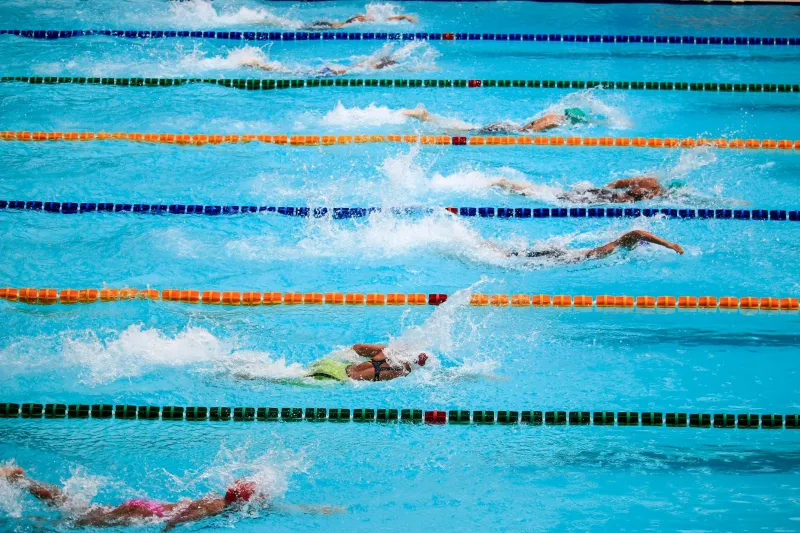
Every time you watch an Olympic swimming final — the kind decided by a fingernail's width at the wall, where slow-motion replays determine who gets gold — you're watching athletes race inside a structure invented by someone who had absolutely no interest in competition. The lane lines slicing that pool into eight perfectly equal corridors were not designed by a sports engineer or a governing body. They were designed by a hotel employee who needed Sunday afternoons to stop being chaotic.
The fact that competitive swimming adopted his solution wholesale, never improved on it in any meaningful way, and eventually handed it the authority to determine Olympic champions is one of the quieter accidents in the history of sport.
The Problem With Popular Pools
In the 1920s, hotel pools were a luxury amenity and a genuine selling point. The big resort hotels along the East Coast and in California had invested heavily in their aquatic facilities, and on a warm Sunday afternoon, those pools were packed. Not with competitive swimmers doing laps. With guests. Regular people splashing around, socializing, floating on their backs, and — this was the operational nightmare — crashing into each other constantly.
A pool full of recreational swimmers moving in different directions at different speeds is essentially a human pinball machine. People got hurt. Guests complained. Hotel managers fielded endless disputes about who had the right of way in the water, a question that had no good answer because nobody had ever thought to establish one.
The solution, when it came, was almost embarrassingly straightforward: divide the pool into corridors using floating rope lines, assign each corridor a direction of travel, and enforce a basic traffic pattern. The ropes kept casual swimmers in their lanes and eliminated most of the collisions. The Sunday afternoon chaos dropped dramatically. The guests stopped complaining.
No one wrote a white paper about it. No one filed a patent. It was a rope in a pool. It worked, so it stayed.
Swimming Borrows a Rope
Competitive swimming in the early twentieth century was a genuinely disorganized affair. Races were held in rivers, harbors, and public baths. Lanes, to the extent they existed at all, were loosely defined by cork floats or painted lines on the pool bottom — neither of which actually kept swimmers separated during a race. Competitors regularly drifted into each other's paths. Races were sometimes reswum because of contact. The sport had an officiating problem with no obvious fix.
At some point in the late 1920s — the exact moment is frustratingly difficult to pin down, which is itself revealing — competitive swimming organizations began adopting the hotel pool's rope-and-float system for race courses. The logic was immediate and practical: if floating lanes kept recreational swimmers separated, they'd keep racing swimmers separated too. The application was different. The technology was identical.
By the time FINA, the international swimming federation, began codifying pool standards in the 1930s, lane lines were already assumed to be part of the competitive environment. Nobody sat in a committee meeting and decided lane lines were a good idea. They were already there. The sport had inherited them from a hospitality solution and never looked back.
A Century of Competitive Inertia
Here is the remarkable part: the lane line you see at the Paris Olympics is functionally identical to the one that kept hotel guests from drowning each other in 1926.
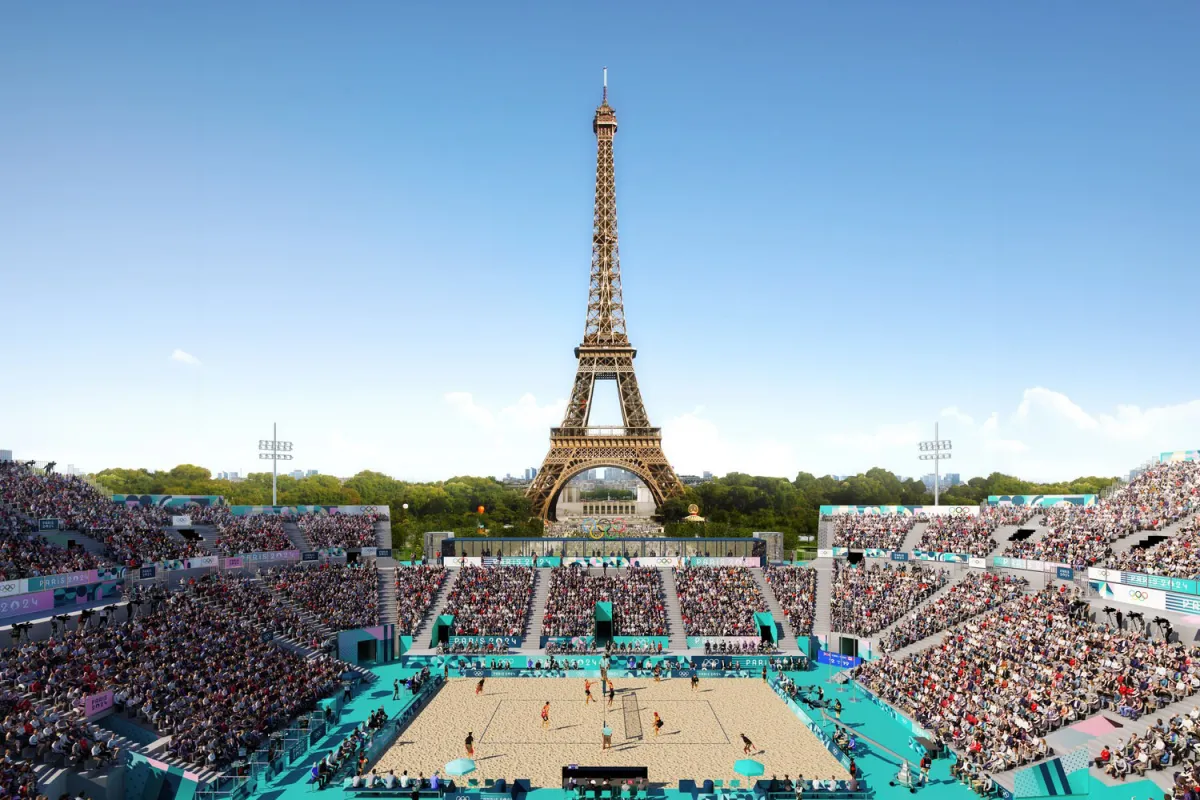 Photo: Paris Olympics, via www.thesouthafrican.com
The materials improved. Early lines were simple cotton rope with cork or wooden floats. Modern lane lines use high-density polyethylene discs on a tensioned cable, and the disc design is engineered to reduce wave turbulence — a refinement that matters enormously at elite levels, where a rogue wave off a powerful swimmer's stroke can cost a competitor in the adjacent lane measurable fractions of a second. The color-coding system became standardized: blue lanes on the outside, yellow in the middle, the coveted center lanes reserved for the fastest heat qualifiers.
But the core concept — a floating barrier dividing the pool into individual corridors — has not changed in a hundred years. The sport has been transformed entirely in that time. Swimsuit technology, stroke technique, training science, pool depth, water temperature management — all of it has been engineered and re-engineered in pursuit of faster times. The lane line sat untouched through all of it, a hotel manager's afterthought holding the whole competition together.
What Lives in the Lane
There's a particular irony in how much weight now rests on that borrowed rope. In the 2008 Beijing Olympics, Michael Phelps won his seventh gold medal of the Games — the 100-meter butterfly — by one hundredth of a second over Milorad Cavic. One hundredth. The margin was so small that Cavic's own team initially believed he'd won. The lane line between them had been doing its job: keeping two of the fastest human beings on earth in perfectly parallel corridors so that the race could be decided by touch and nothing else.
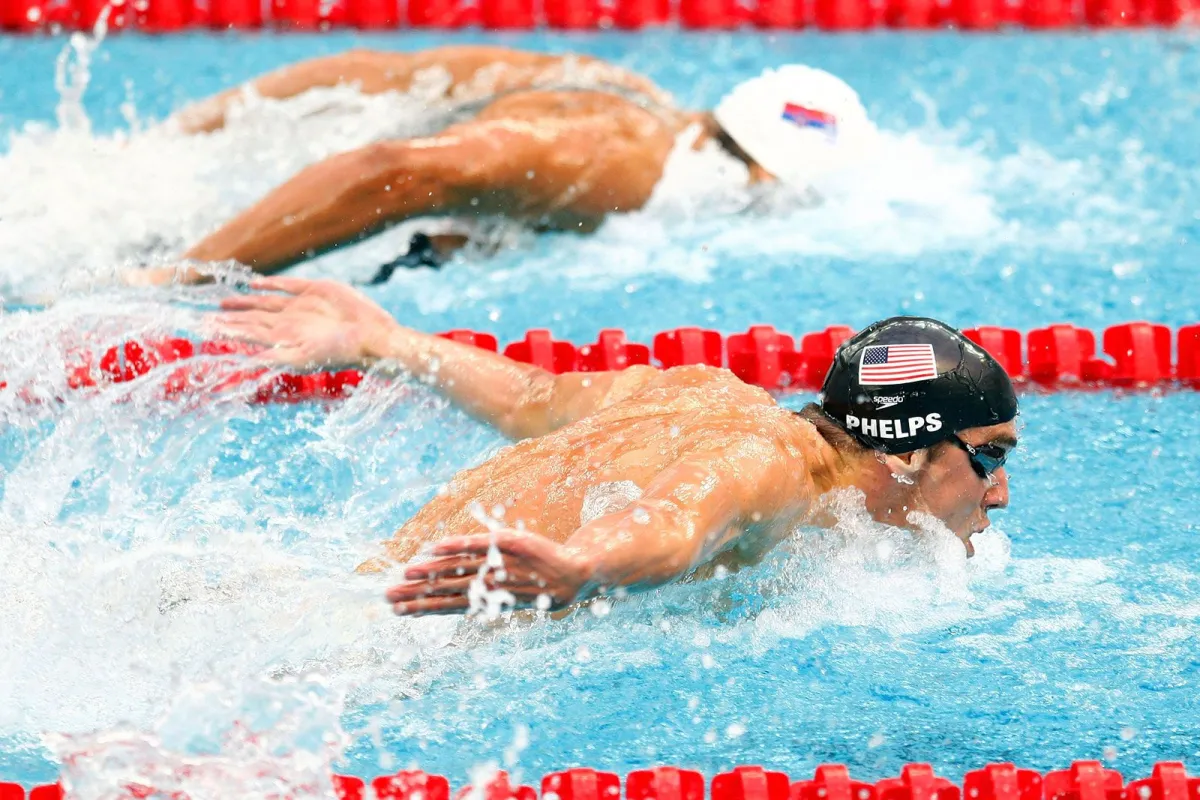 Photo: Michael Phelps, via cdn.britannica.com
 Photo: Beijing Olympics, via www.usmagazine.com
Without lane lines, that race doesn't exist in any meaningful form. Without the hotel pool manager who first strung a rope across a crowded Sunday afternoon, the infrastructure for that moment doesn't exist either.
The Invisible Architecture of Sport
Most sports have a moment of invention — a committee meeting, a patent filing, a rule book written in a specific place on a specific date. Lane lines have none of that. They exist in the competitive record as an inherited assumption, a solution that arrived from outside the sport and was never formally invited in.
Swimming's governing bodies eventually wrote the technology into their regulations, specified the dimensions, standardized the colors, and published the approved wave-dampening tolerances. But they were codifying something that had already happened, ratifying a borrowed idea that the sport had been quietly using for years before anyone thought to make it official.
The hotel manager never got a footnote. The rope became Olympic infrastructure. That's usually how it goes with the things that matter most — they don't announce themselves. They just quietly become load-bearing.