Deadline Pressure and a Chaotic Ballpark: How Journalists Accidentally Built the Press Box
Photo: The Library of Congress, No restrictions, via Wikimedia Commons
The next time you watch a major league game on television and the broadcast cuts to a camera angle high above home plate — that clean, elevated view that shows the whole field laid out like a diagram — you're seeing the descendant of a crisis. A logistical crisis that unfolded in the early 1900s, involving a mob of reporters, a telegraph operator who couldn't hear himself think, and a team owner who was furious about all of it.
The sports press box is so standard a feature of American stadiums that it barely registers as a design decision. It's just there, glassed-in and elevated, a row of screens and laptops above the regular crowd. But it didn't come from an architect's blueprint or a league mandate. It came from desperation.
When Reporters Were Just Fans With Notebooks
In the early years of professional baseball — roughly from the 1870s through the first decade of the 1900s — newspaper coverage of games was already a serious business. Circulation wars between competing city papers meant sports coverage sold copies, and editors dispatched reporters to games with the same urgency they sent them to courthouses and city halls.
But those reporters sat in the stands. There was no dedicated media section, no elevated vantage point, no infrastructure for filing a story in anything resembling real time. A reporter at a ballgame in 1903 had the same seat as any other ticket holder. He'd take handwritten notes, return to the newsroom after the final out, and write his account for the next morning's edition.
This worked — barely — until telegraph technology started changing what editors expected. By the early 1900s, papers in cities without a local team wanted same-day coverage of road games and, increasingly, inning-by-inning score updates that could be printed in afternoon editions. That meant reporters needed access to a telegraph wire, ideally from inside the ballpark, during the game itself.
The World Series Changes Everything
The 1908 World Series between the Chicago Cubs and the Detroit Tigers is widely cited as the breaking point, though the pressure had been building for years across multiple ballparks. What made that series different was the scale of national interest and the corresponding explosion in the number of reporters trying to cover it simultaneously.
 Photo: Detroit Tigers, via bucket-revetee.storage.googleapis.com
 Photo: Chicago Cubs, via cdn.abcotvs.com
Estimates suggest that dozens of reporters from papers across the country descended on the series games, all needing to file updates by wire. They crammed into whatever seats they could find, which put them in the middle of partisan crowds that were, to put it charitably, not concerned with journalistic working conditions. Fans shouted, jostled, spilled things, and occasionally took exception to what reporters were writing. Telegraph operators — who needed to be on-site to transmit copy — couldn't hear the Morse code signals over the crowd noise. Copy was delayed, garbled, or lost entirely.
Team owners and league officials, who had a commercial interest in accurate and enthusiastic press coverage, were confronted with an obvious structural problem: the people responsible for telling America about baseball couldn't actually do their jobs from inside a baseball stadium.
The Makeshift Solution That Became Permanent
The fix, when it came, was pragmatic rather than elegant. Ballpark operators began designating specific sections — initially just roped-off rows in the upper deck — where reporters could work without being surrounded by general admission crowds. Telegraph lines were run directly to these areas so operators could transmit without fighting ambient noise. A roof or overhang was added in some parks to keep equipment dry.
It was a patch job, not a plan. But it worked well enough that when teams began building new stadiums in the 1910s and 1920s — the era of the great concrete-and-steel ballparks that replaced the earlier wooden structures — the dedicated press area was incorporated into the design from the start. Architects drew it in because owners demanded it. Owners demanded it because the 1908 series and games like it had made the cost of not having one painfully clear.
Pittsburgh's Forbes Field, which opened in 1909, is often credited as one of the first parks to include a purpose-built press area in its original construction. Others followed through the 1910s and 1920s, each one a little more deliberate, a little more elevated, a little more separated from the fan sections below.
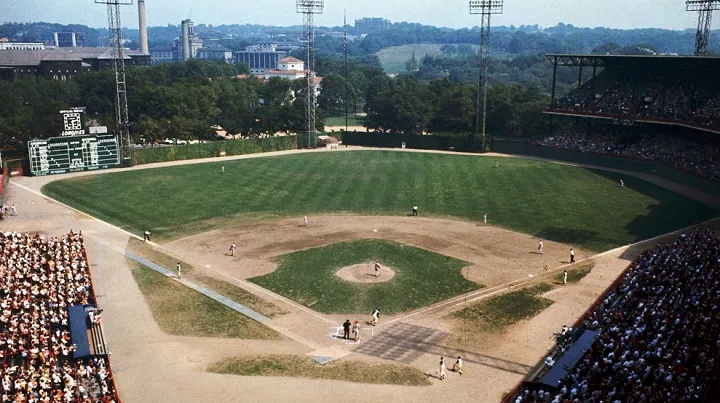 Photo: Forbes Field, via www.ballparksofbaseball.com
From Wire Service to Broadcast Booth
The press box's evolution tracked almost exactly with the evolution of sports media itself. When radio broadcasting arrived in the 1920s, the dedicated press area expanded to accommodate broadcast equipment and the engineers who operated it. The elevated, enclosed design that had been developed for telegraph operators turned out to be nearly ideal for radio commentary — good sightlines, separation from crowd noise, and enough physical space for bulky early broadcast gear.
Television, when it arrived in force after World War II, pushed the same logic further. The camera positions that now define how Americans watch baseball — the high home plate camera, the center field angle — are direct descendants of the elevated press box placement that telegraph deadlines forced into existence four decades earlier.
The NFL, the NBA, and the NHL each inherited the press box convention wholesale as their own stadium construction programs accelerated through the mid-twentieth century. By the time indoor arenas became standard for basketball and hockey, the elevated media area was simply assumed to be part of the building. Nobody redesigned it from scratch. They copied what baseball had built under pressure.
The Accidental Architecture of American Sports
What's quietly remarkable about the press box story is how much of America's visual relationship with sports flows from a problem that nobody planned to solve architecturally. The way a game looks on television — the angles, the perspective, the sense of the whole field visible at once — was shaped by the need to keep telegraph operators from being jostled by angry fans during a World Series game.
Deadline pressure, not design thinking, built the modern press box. And the modern press box, more than almost any other structural feature of an American stadium, built the way sports looks in this country.